

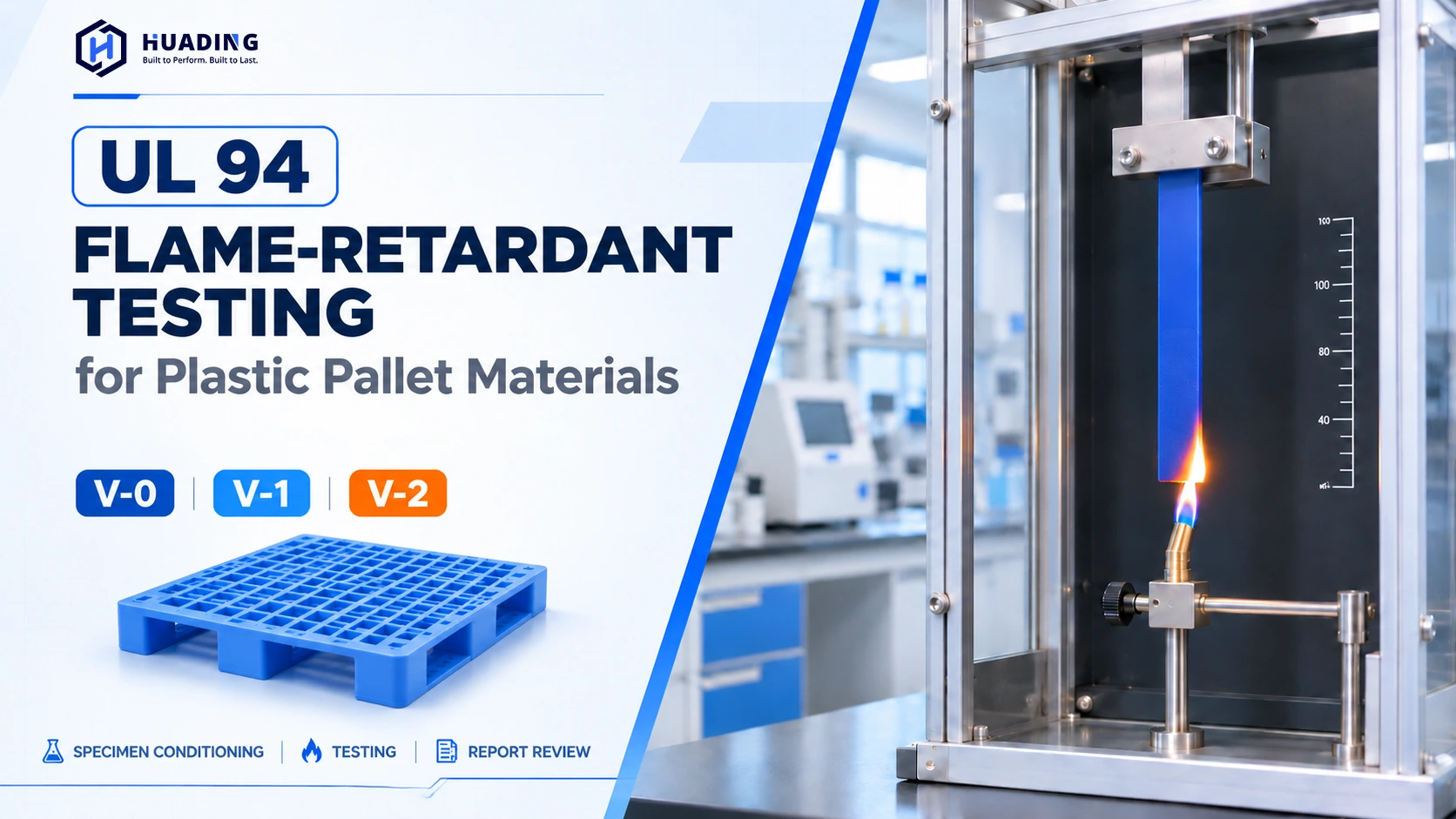
From Specimen Conditioning to Test Report Review
When sourcing flame-retardant plastic pallets, buyers often focus on one question: Which UL 94 classification does the material meet?
The supporting report should identify the material, tested thickness and conditioning used to establish that classification.
The 50 W vertical test evaluates prepared material specimens after the prescribed conditioning. The process includes separate specimen groups, controlled flame applications, recorded burning observations and a review against the classification criteria.
At HUADING, we pay attention not only to material requirements but also to the testing procedures used to verify them.
Need to confirm a material requirement? Discuss your pallet specification with HUADING.
1. What Does the UL 94 Vertical Burning Test Evaluate?
UL 94 is a standard used to evaluate the flammability characteristics of plastic materials under controlled laboratory conditions.
The 50W (20 mm) vertical burning test is used to determine three commonly specified classifications: V-0, V-1 and V-2.
During the test, plastic specimens are mounted vertically and exposed to a specified flame. The laboratory evaluates several aspects of their burning behavior:
- Afterflame time
- How long the specimen continues to burn after the test flame is removed.
- Afterglow time
- How long the specimen continues to glow after visible flaming stops.
- Flaming drips
- Whether burning particles or molten drops fall from the specimen.
- Cotton indicator ignition
- Whether falling flaming particles or drops ignite the cotton indicator below the specimen.
- Burning to the holding clamp
- Whether the flame or afterglow reaches the upper holding area.
These observations are evaluated together. A material classification cannot be determined simply by checking whether the specimen eventually extinguishes itself.
It is also important to understand the scope of this test. UL 94 evaluates plastic material specimens under defined laboratory conditions. A material classification does not automatically represent the fire-safety performance or certification of an entire finished plastic pallet.
2. Specimen Preparation: What Happens Before Testing?
Before the burning test begins, the laboratory must prepare specimens according to the applicable test requirements.
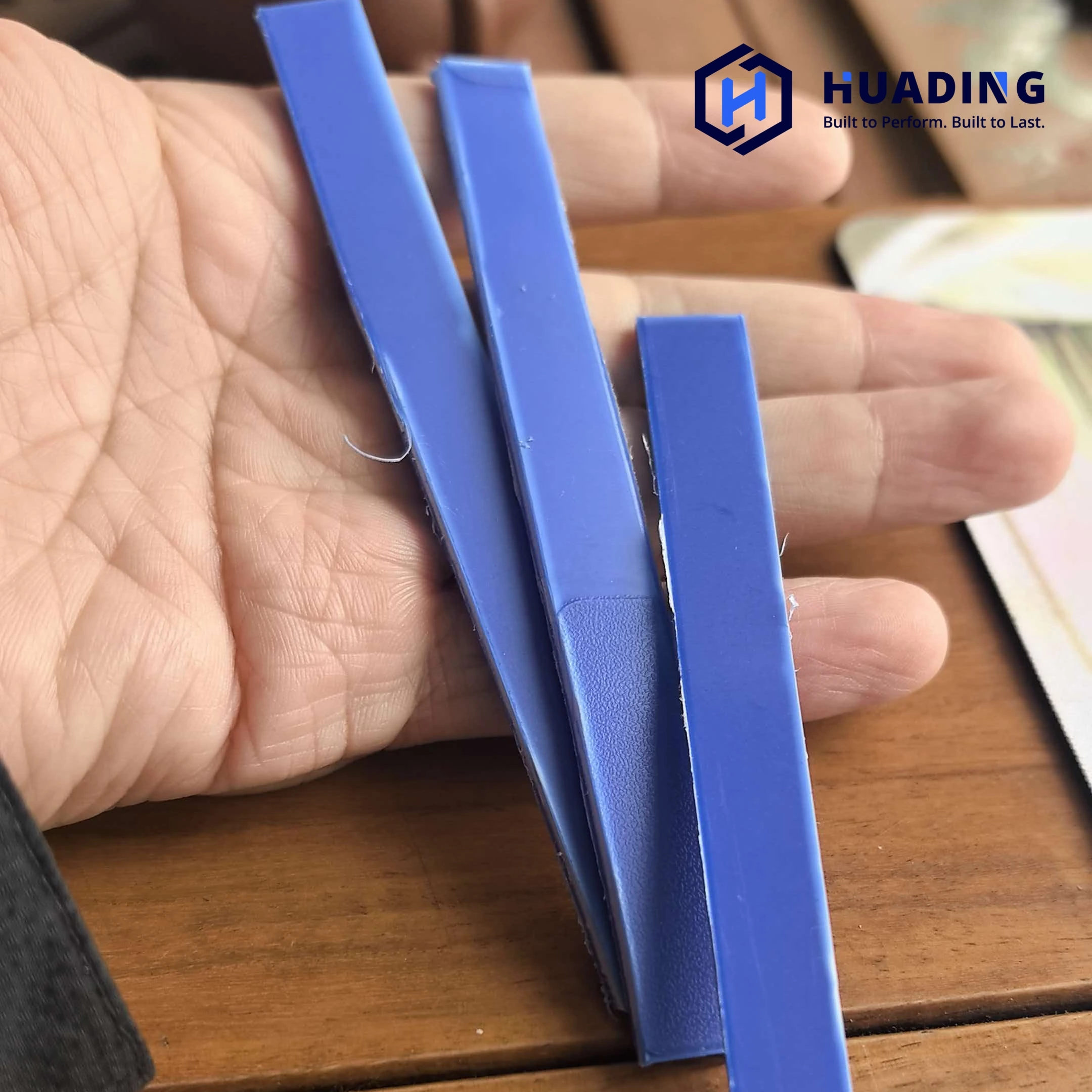
This preparation stage includes:
- Recording the submitted material grade, formulation reference and colour.
- Preparing specimens in the required dimensions.
- Confirming and recording the specimen thickness.
- Arranging specimens for the required conditioning procedures.
- Checking that the specimens are suitable for the subsequent testing stages.
Read the result together with the material identity and specimen thickness recorded in the report.
Check that the submitted sample can be traced to the material proposed for production.
3. How Are Specimens Conditioned Before Testing?
The 50 W vertical test uses separate specimen groups for the prescribed laboratory and oven conditioning.
Standard Environmental Conditioning
One group of specimens is conditioned under controlled laboratory conditions:
- Temperature: 23°C
- Relative humidity: 50%
- Duration: 48 hours
These are nominal values. The laboratory applies the full conditioning requirements and tolerances of the standard edition used.
Oven Conditioning
A separate specimen group is conditioned in a hot-air oven:
- Temperature: 70°C
- Duration: 7 days
After oven conditioning, the specimens are cooled under the conditions specified by the applicable test procedure before testing.
Planning the Conditioning Schedule
These treatments establish controlled conditions for the flammability evaluation. Confirm the applicable conditioning and cooling requirements when planning the laboratory schedule.
Account for the separate specimen groups, the seven-day oven treatment, prescribed cooling and the laboratory's testing capacity. The treatment establishes a condition for the burning test. Long-term service-temperature performance requires its own assessment.
4. How Is the 50W (20 mm) Vertical Burning Test Performed?
After specimen preparation and conditioning are completed, the laboratory proceeds with the actual vertical burning evaluation.
The standard procedure involves several important steps:
Step 1: Specimen Installation
The prepared specimen is mounted vertically in the designated test apparatus.
Step 2: First Flame Application
A specified 20 mm test flame is applied to the lower end of the specimen for 10 seconds. After the flame is removed, the laboratory records the first afterflame time, identified as t1.
Step 3: Second Flame Application
After the first afterflame has ceased, the specimen undergoes a second 10-second flame application according to the test method. The laboratory then records t2 (afterflame time following the second flame application) and t3 (afterglow time following the second flame application).
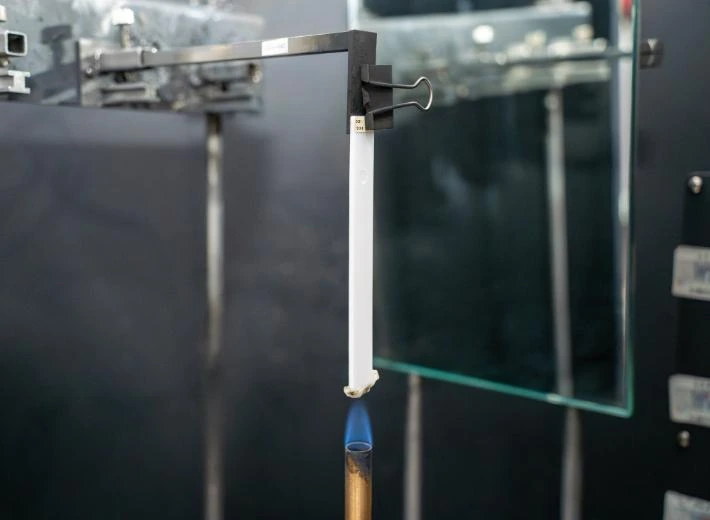
Step 4: Burning Behavior Observation
Throughout the test, the laboratory observes whether the flame or afterglow reaches the specimen holding clamp, whether burning particles or molten drops fall from the specimen, and whether falling flaming particles or drops ignite the cotton indicator below.
Step 5: Test Data Recording
The measured times and observations are recorded for the required specimens under each conditioning condition. The final classification depends on the complete set of applicable test results and the relevant classification requirements.
5. What Are the Differences Between V-0, V-1 and V-2?
Although V-0, V-1 and V-2 are all vertical burning classifications, their acceptance criteria are different.
The following table summarizes the main requirements for the UL 94 50W (20 mm) vertical burning test.
| Evaluation Criteria | V-0 | V-1 | V-2 |
|---|---|---|---|
| Individual afterflame time (t1 and t2) | ≤10 s | ≤30 s | ≤30 s |
| Total afterflame time for 10 flame applications | ≤50 s | ≤250 s | ≤250 s |
| Afterflame + afterglow after the second flame application (t2 + t3) | ≤30 s | ≤60 s | ≤60 s |
| Burning or afterglow reaching the holding clamp | Not permitted | Not permitted | Not permitted |
| Flaming drops igniting the cotton indicator | Not permitted | Not permitted | Permitted |
Compare all three classifications; on narrow screens, scroll the table horizontally.
The key distinction between V-1 and V-2 is the behavior of flaming drips.
Both classifications have the same main afterflame time limits, but V-1 does not permit flaming particles or drops to ignite the cotton indicator, while V-2 allows this result under the classification criteria.
V-0 has more stringent afterflame and afterglow time requirements.
For buyers, the appropriate classification should be determined by the actual project specification and intended application rather than simply choosing the highest available rating.
6. What Affects UL 94 Test Turnaround Time?
Laboratory turnaround includes sample preparation, conditioning, testing, data review and report issue.
When confirming a schedule, ask the laboratory about specimen preparation, the conditioning plan, available test slots and the expected report date.
Also confirm how additional thicknesses, colours or repeat tests would affect timing. Agree on the overall lead time for the submitted material and test scope.
For projects involving the full conditioning sequence and third-party laboratory evaluation, the overall process may extend to around 12 days. This is an estimated project timeline, not a fixed period specified by UL 94. The actual schedule should be confirmed with the laboratory based on the test scope, available testing slots and report requirements.
7. HUADING Flame-Retardant Plastic Pallet Options: V-0, V-1 and V-2
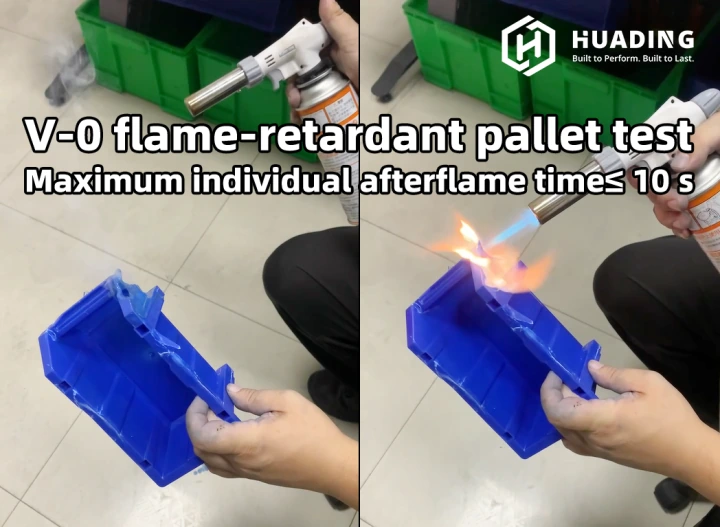
Different industrial applications may require different levels of flame-retardant performance.
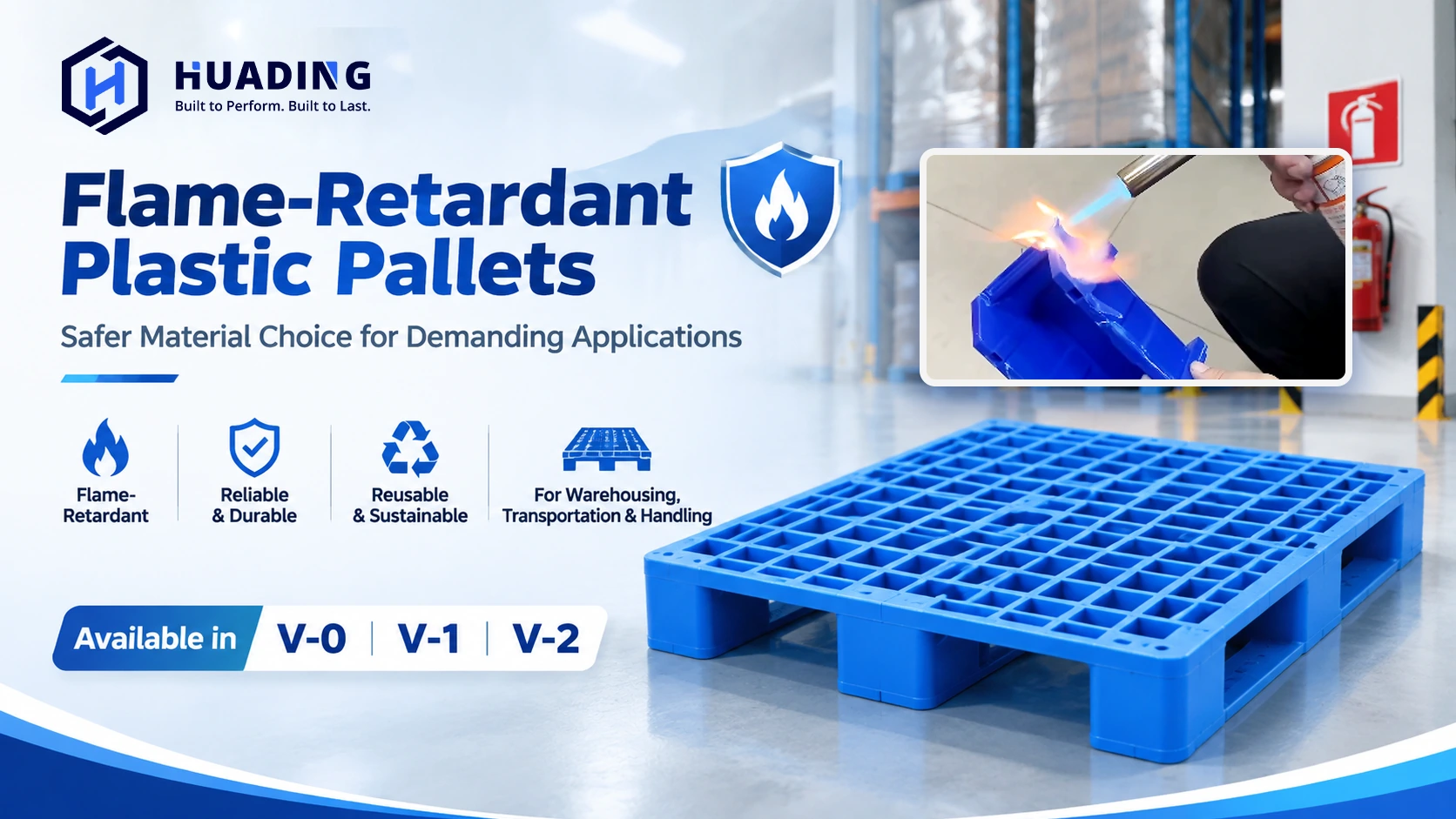
HUADING provides flame-retardant plastic pallet options for projects specifying V-0, V-1 and V-2 requirements.
The appropriate option depends on the customer's target classification, material formulation, specimen thickness and intended application.
A classification should only be claimed when supported by appropriate test evidence for the relevant material and thickness. Different formulations, colours and thicknesses should not automatically be assumed to have identical flammability performance.
When evaluating a flame-retardant pallet, we recommend confirming the following information before ordering:
- Required classification: Is the project specification V-0, V-1 or V-2?
- Applicable test standard: Is UL 94 the required test method?
- Tested thickness: Does the test evidence correspond to the material thickness required for the pallet?
- Material formulation: Does the test report refer to the same material formulation used for production?
- Product application: Does the selected pallet configuration meet the intended warehouse, transportation and handling requirements?
For a more detailed comparison of the three classifications and the key points buyers should verify before ordering, see our related guide:
V-0 vs V-1 vs V-2: What Buyers Should Check Before Ordering a Flame-Retardant Plastic Pallet
8. What Should Buyers Check in the Test Report?
Retain the report with the purchase specification so purchasing, engineering and quality teams can review the same evidence.
- Report identity. Record the laboratory, report number, issue date and standard edition.
- Test scope. Match the material grade, colour, specimen thickness and conditioning to the submitted sample.
- Results and traceability. Check the reported class against the recorded times and observations, and connect the tested sample to the material proposed for production.
If the project specifies UL Recognized material, check the current material listing and its recognised thickness and colour scope during the document review.
Confirm the Evidence Before Ordering
A procurement review should connect the requested classification, the submitted material, the laboratory result and the proposed production specification.
Share your required UL 94 classification, pallet dimensions, load, quantity and application environment with HUADING. Include any customer-specified test or documentation requirements so our team can review product options and testing needs before ordering.
Technical note: UL 94 V-0, V-1 and V-2 are flammability classifications for plastic material specimens tested under specified laboratory conditions. They should not be interpreted as fire-resistance ratings or fire-safety certifications for an entire finished plastic pallet. Additional product-level or site-specific fire-safety requirements may apply.
Technical reference: UL Solutions – Combustion (Fire) Tests for Plastics