Views: 11 Author: Site Editor Publish Time: 2026-03-05 Origin: Site

Many procurement teams receive one high-risk question: “Is this pallet rackable?” In real warehouses, rack safety failures often begin with a structural mismatch — pallets intended for floor stacking placed onto rack beams. This guide explains what “rackable” truly means, how racking load differs from static/dynamic ratings, why beam span matters, and what technical evidence buyers should request before approving pallets for racking storage.
Many buyers assume that a plastic pallet can automatically be used in warehouse racking systems.
In reality, this assumption is often incorrect.
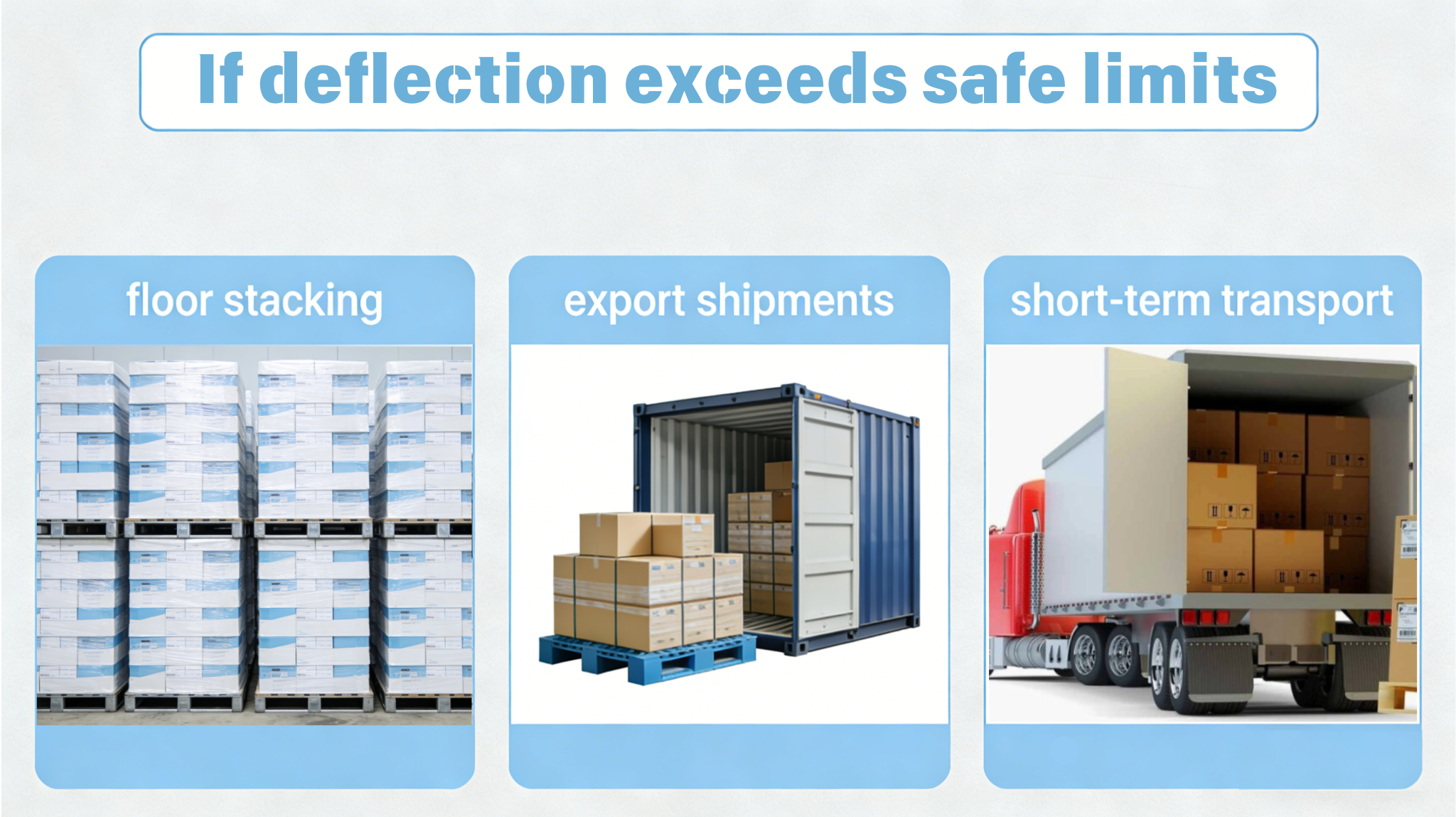
Most plastic pallets are designed for:
floor stacking
export shipments
short-term transport
But racking storage introduces a completely different load condition.
When a pallet is placed on warehouse beams, the structure is supported only at two points.
The entire load must be carried across the span between the beams.
If the pallet structure is not engineered for this condition, it may:
bend excessively
lose structural stiffness
damage goods
create safety risks
This is why industrial buyers must clearly understand what makes a pallet truly rackable.
A rackable pallet is designed to safely carry load when supported only by rack beams.
This requires:
controlled structural deflection
reinforced load paths
sufficient bending resistance
Unlike floor stacking, where load is distributed across the pallet base, racking concentrates structural stress in the middle span.
This makes beam deflection the critical engineering parameter.
If deflection exceeds safe limits:
products may tilt
pallets may permanently deform
warehouse racks may be stressed
For this reason, rackable pallets must be evaluated under beam-supported testing conditions.
Many RFQs request “load capacity,” but few define how it should be measured.
Industrial pallet load capacity is normally divided into three categories.
Static load refers to the weight a pallet can support while resting on a flat surface without movement.
In this condition, load is evenly distributed across the pallet base.
This number is typically the highest load rating.
Dynamic load refers to the weight a pallet can support while being moved.
This includes:
forklift transport
pallet jack movement
warehouse handling
Dynamic load ratings are lower because movement introduces impact and vibration forces.
Racking load refers to the weight a pallet can support when placed across warehouse rack beams.
This is usually the lowest load rating, because the pallet must span open space between supports.
For industrial buyers using racking systems, racking load is the most important specification.
Plastic materials behave differently from wood or steel.
Under sustained load, plastic can slowly deform over time — a phenomenon known as creep.
When a pallet is stored on racking beams for extended periods:
the center span experiences continuous bending stress
deformation increases gradually
structural stiffness decreases
Without reinforcement, plastic pallets may sag under load.
This is why rackable pallets often include steel bar reinforcement or specialized rib structures.
These design elements dramatically increase bending resistance.
Rackable pallets rely heavily on engineering design.
Key structural factors include:
The underside of a pallet contains reinforcing ribs.These ribs act as structural beams distributing load across the pallet surface.
Deeper ribs generally improve bending resistance.
Well-engineered pallets align rib direction with racking beams to minimize mid-span deflection.
Uniform thickness is not always optimal.
Engineered pallets increase thickness in high-stress zones to strengthen load paths.
Excess thickness without proper cooling control can introduce warpage and internal stress.
Engineering precision matters more than bulk material usage.
Many heavy-duty rackable pallets integrate steel bars inside the pallet structure.
Steel bars:
increase stiffness
reduce mid-span deflection
improve racking performance
They are particularly common in 1200 × 1000 mm and 1200 × 800 mm rackable pallets used in European warehouses.
Proper integration must balance stiffness and plastic flexibility to avoid cracking at stress points.
Good pallet design ensures that load flows efficiently from the deck surface into the structural ribs and base.
Poor design leads to stress concentration and premature deformation.
Professional pallet manufacturers validate rackable performance through controlled testing.
Typical racking load testing involves:
supporting the pallet only on rack beams
applying the rated load evenly across the deck
measuring deflection at the center span
maintaining the load for a defined duration
Key metrics recorded include:
maximum deflection
permanent deformation after unloading
safety factor applied in design
Industrial buyers should request racking load test reports before approving a pallet for rack storage.
Racking load capacity is heavily influenced by beam spacing.
For example:
Beam span: 900 mm
Racking load capacity: higher
Beam span: 1100 mm
Racking load capacity: lower
This means that a pallet rated for racking at one span may not perform safely at another.
Buyers should confirm:
beam spacing in their warehouse
pallet testing span
safety factor used by the supplier
Misalignment between these parameters can create hidden risk.
Many procurement mistakes occur because buyers focus only on price.
Typical errors include:
assuming all plastic pallets are rackable
ignoring beam span in testing data
not requesting load test reports
selecting pallets without reinforcement
using export pallets in racking systems
These decisions often lead to:
pallet deformation
product damage
rack safety concerns
premature replacement
Engineering validation prevents these problems.
Not every operation requires rackable pallets.
However, certain warehouse environments make rackable pallet performance essential.
Typical scenarios include:
When products are stored in pallet racking systems, pallets must maintain structural stability across beam spans.
Manufacturing parts, automotive components, and industrial equipment often exceed the capacity of standard export pallets.
Automation systems depend on dimensional consistency. Rackable plastic pallets offer predictable structure and repeatable dimensions, improving automation compatibility.
Rackable pallets typically cost more than standard export pallets.
However, cost should be evaluated across the pallet lifecycle.
Factors influencing long-term cost include:
Standard pallets used in racking systems often deform prematurely. Rackable pallets maintain structural integrity longer, reducing replacement cycles.
Pallet deflection can cause goods to tilt or shift. Rackable pallets reduce this risk through stronger structural design.
Rack systems depend on pallet stability. Risk reduction provides measurable operational value.
Modern warehouses increasingly rely on automation.
Automation systems require pallets with:
consistent dimensions
stable deck surfaces
predictable structural behavior
Plastic pallets designed for racking are often better suited for automation environments.
Advantages include:
dimensional precision from injection molding
smooth surfaces compatible with conveyor systems
structural repeatability across production batches
Wood pallets often vary in shape and stiffness, which can interfere with automated systems.
For warehouses planning automation upgrades, pallet standardization becomes a strategic investment.
Choosing the correct rackable pallet requires understanding several technical factors.
Key questions procurement teams should ask include:
Load requirements: What is the maximum product weight placed on the pallet?
Racking beam spacing: What is the distance between rack beams in the warehouse?
Storage duration: Will pallets remain in racking for hours, days, or weeks?
Handling equipment: Will pallets be moved by forklifts, pallet jacks, or automated systems?
Environmental conditions: Temperature and humidity may affect material performance.
Before purchasing rackable pallets, procurement teams should confirm the following:
✔ Verified racking load capacity
✔ Racking load test report available
✔ Beam span used in testing documented
✔ Maximum allowable deflection defined
✔ Reinforcement structure explained
✔ Material type specified (HDPE or PP)
✔ Dimensional tolerances documented
These criteria help ensure that pallet performance matches warehouse requirements.
Rackable pallets are not simply stronger pallets.
They are engineered structural components within warehouse storage systems.
When pallet design aligns with racking conditions, warehouses benefit from:
improved load stability
reduced product damage
enhanced operational safety
longer pallet lifespan
Understanding structural requirements helps procurement teams select pallets that support both operational efficiency and long-term cost control.
Huading Industry designs and manufactures industrial plastic pallets engineered for demanding warehouse environments.
Our rackable pallet solutions are developed for:
warehouse racking systems
heavy-duty industrial loads
automated logistics environments
closed-loop returnable packaging systems
Our engineering team provides load testing data, material specifications, and application guidance to help buyers select the right pallet for their storage conditions.

If your warehouse uses pallet racking, our team can help evaluate required racking load capacity, beam spacing compatibility, reinforcement configuration, and pallet lifecycle expectations. Contact our engineering team to discuss your application and receive technical documentation for rackable pallet solutions.
Contact Huading Engineering Team
