Views: 57 Author: Site Editor Publish Time: 2026-07-29 Origin: Site

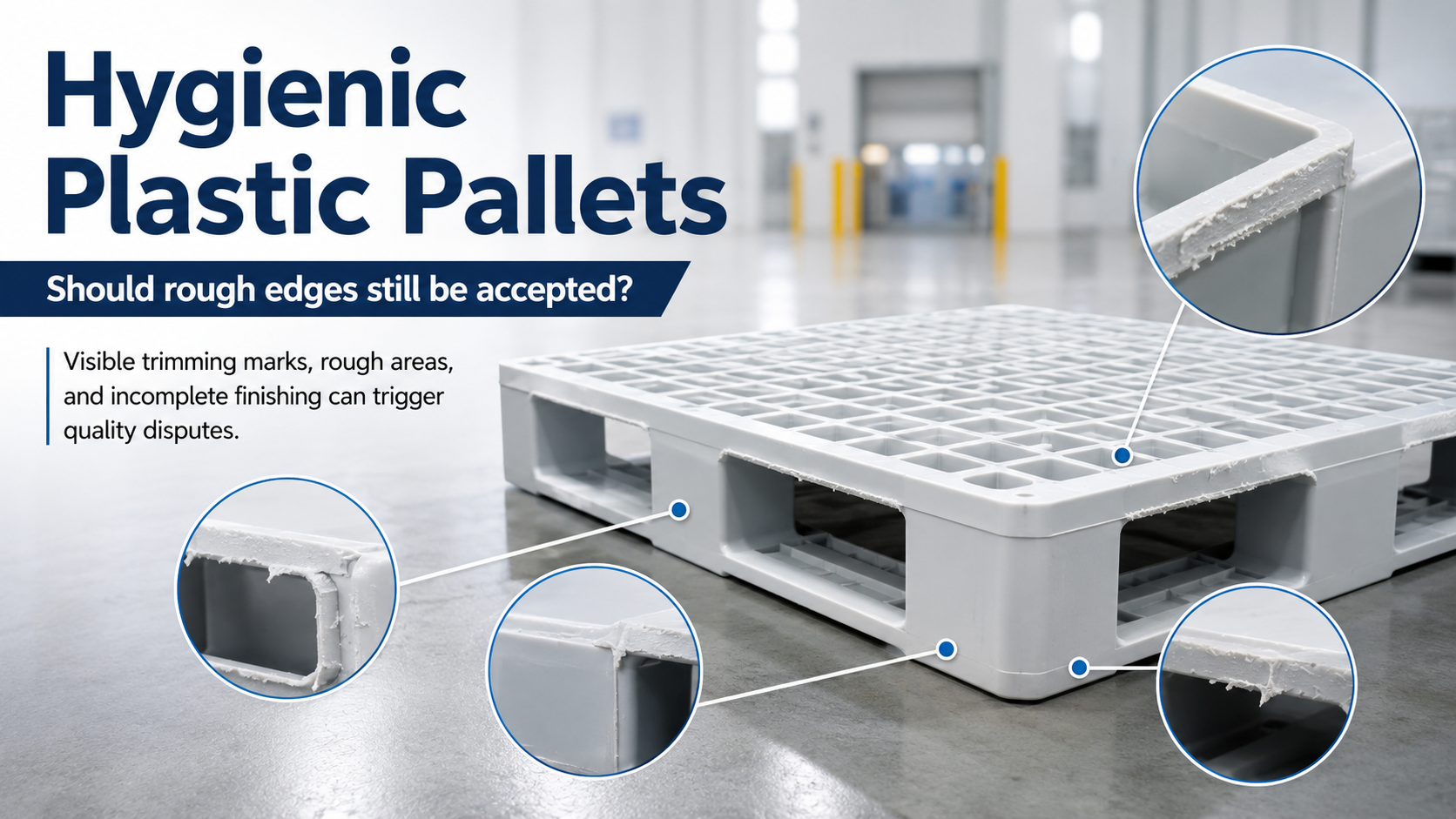
A plastic pallet meets the required load capacity. Its dimensions are correct. The specified material has been used. But several edges show visible trimming marks, rough areas, or incomplete finishing. Should the pallet still be accepted as a hygienic pallet?
This is where quality disputes often begin.
Some suppliers and buyers evaluate pallet quality mainly through structural performance — if the pallet carries the required load and remains usable, a minor surface imperfection is treated as cosmetic. Other buyers, particularly those in food processing, cold-chain logistics, pharmaceutical distribution, or other hygiene-sensitive environments, apply a different standard: the pallet must also have surfaces, edges, joints, and recesses that can be cleaned consistently and inspected reliably during repeated use.
Neither side is necessarily being unreasonable. The real problem is that the term "hygienic pallet" is often used before the acceptance criteria behind it have been clearly defined.

There is no single test result that automatically proves a pallet is suitable for every hygiene-sensitive application. Different requirements address different aspects of pallet performance, and they do not always overlap:
| Standard / Guidance | What It Covers | What It Does Not Cover |
|---|---|---|
| ISO 8611 | Structural performance — nominal load, maximum working load, durability of flat pallets | Does not establish a complete hygiene classification for plastic pallets |
| EU Food Hygiene Rules | Smooth, washable, corrosion-resistant, non-toxic materials in food-handling environments; prevention of contamination | Does not define a universal pallet surface defect table |
| FDA Food Transport Guidance | Adequate cleaning, protection from contamination, removal of damaged containers from food-handling use | Does not specify acceptable pallet surface imperfection limits |
| Pharma GMP Guidance | Exposed surfaces smooth, free from cracks or open joints, capable of effective cleaning in controlled environments | Not a universal plastic-pallet defect table; requirements vary by environment and product |
A hygienic pallet should be judged by whether it remains suitable for the environment in which it will be used — not only by whether it can carry a load.
Consider a common project scenario: a batch of pallets meets the agreed dimensions, material, and load conditions. During final inspection or after delivery, however, some pallets are found to have rough trimmed edges, open areas around a welded section, or surface damage.
Structurally, the pallets may remain usable. But if the application requires frequent washing, controlled sanitation, or strict visual inspection, those defects can change the commercial status of the entire batch:
A practical hygienic-pallet assessment should cover four dimensions — not load performance alone.
Static, dynamic, or racking requirements; load distribution; forklift and equipment compatibility; dimensional tolerances. A pallet that is easy to clean but cannot safely support the intended load is not suitable — but passing a load test does not automatically prove the pallet meets hygiene requirements either.
The specified polymer and whether virgin or recycled material is required; chemical resistance related to the cleaning process; and whether the pallet will directly contact exposed food — since that is not automatically the same regulatory situation as being used somewhere within the food industry more broadly.
Cracks, open joints, incomplete welded areas, sharp burrs, and areas that may retain residue or moisture. The key distinction is between a visible production mark and a functional hygiene defect. A surface doesn't need to be visually perfect to be functional — but it should not compromise cleanability or handling safety.
Terms like "smooth," "hygienic," or "no burrs" can be interpreted differently. A reliable specification should define which surfaces are critical, what type of trimming mark is permitted, whether welded sections must be fully closed, and how inspection will be conducted — sampling, measurement, or physical limit samples.
Not every visible imperfection makes a pallet defective. The decision should be based on four factors — not on appearance alone:
| FACTOR 1 Location | FACTOR 2 Depth & Sharpness | FACTOR 3 Effect on Cleanability | FACTOR 4 Structural Impact |
| Imperfection Type | Typical Location | Risk Factor | Verdict |
|---|---|---|---|
| Minor gate mark, smooth surface | Non-critical, non-contact area | No cleanability impact | Accept |
| Fine parting-line mark | Non-food-contact deck surface | Minimal — does not retain residue | Accept |
| Cosmetic colour variation | Any surface | None — appearance only | Accept |
| Rough trimmed edge | Deck edge or runner | Possible moisture retention; evaluate depth | Evaluate |
| Incomplete weld or fusion gap | Any joint or structural connection | Enclosed void — traps moisture and residue | Reject |
| Crack or open joint | Food-contact or cleanable surface | Direct contamination risk; not cleanable | Reject |
| Sharp burr or protruding edge | Any edge or handling surface | Handling injury risk; also traps residue | Reject |
| Recess or pocket retaining moisture | Interior surface or underside | Cannot be dried or cleaned reliably | Reject |
The most effective way to reduce disputes is to convert a general product description into a controlled purchasing specification. Before production, buyer and supplier should confirm the following:
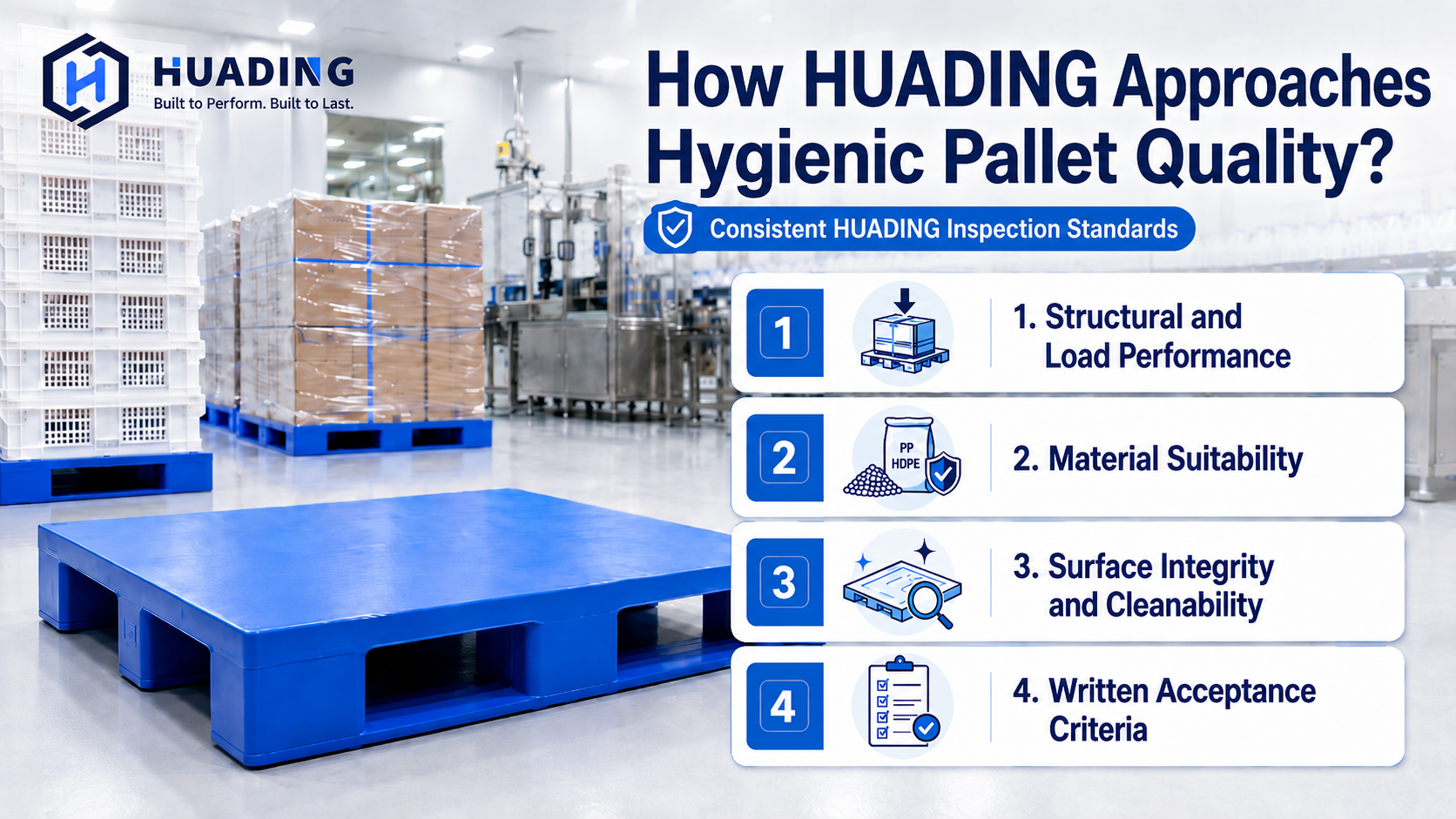
With 20 years of plastic pallet manufacturing experience, Huading understands that consistent pallet quality cannot be evaluated through load performance alone. For pallets intended for food logistics, pharmaceutical distribution, clean storage, or other hygiene-sensitive applications, we give attention to:
Before your next order, ask your supplier: how do you define and inspect an acceptable surface, and which defects would trigger rework or rejection?
Send Huading your required pallet size, loading conditions, intended application, cleaning method, and surface inspection requirements. We will help identify a suitable standard pallet and clarify acceptance criteria before production begins.
Contact Us →
